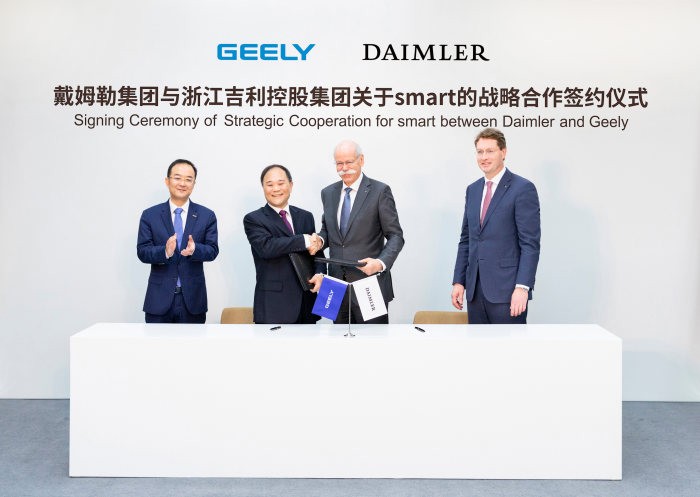
Daimler and Geely Holding form global joint venture to develop smart

28.

March 2019

Stuttgart, Germany; Hangzhou, China

50:50 joint venture between Daimler and Geely based in China to develop and operate smart brand globally as all electric carmaker smart to gain shared expertise in manufacturing, engineering and design from both groups smart to expand to meet demand for electrification, with production based in China New smart models planned from 2022 in all-electric product renewal 28 March 2019, Stuttgart, Germany; Hangzhou, China. Daimler AG (Daimler) and Zhejiang Geely Holding Group (Geely Holding), the German and Chinese automotive groups, today announced the formation of a 50-50 globally focused joint venture to own, operate and further develop smart, the pioneer of small urban vehicles, as a leader in premium-electrified vehicles.
Under the joint venture agreement, a new generation of smart electric models will be assembled at a new purpose-built electric car factory in China with global sales due to begin in 2022.
Dieter Zetsche, Chairman of the Board of Management of Daimler AG and Head of Mercedes-Benz Cars, said: “For more than 2.2 million customers, smart represents a pioneer in urban mobility. Based on this success story, we look forward to further enhancing the brand with Geely Holding, a strong partner in the electric vehicle segment. We will jointly design and develop the next generation of smart electric cars that combine high-quality production and known safety standards for sale both in China and globally. In the future, we are looking forward to working with all partners to sustain our success in China and worldwide. Separately, Mercedes-Benz will produce a compact electric vehicle at the Hambach plant, sustaining employment with further investment in the facility.”
Li Shufu, Geely Holding Chairman, added: “We fully respect the value of smart. This brand has a unique appeal and strong commercial value. Geely Holding and Daimler look forward to this challenging and exciting new project, through which we will further push the introduction of premium electric products to give a better mobility experience to our customers. As equal partners, we are dedicated to promoting the smart brand globally; we will leverage our experience and global competencies in brand management, R&D, manufacturing, supply chain management and other areas. The synergies from this cooperation will lead to mutual benefits, at the same time we will further develop technologies for smart including connectivity, to continue to lead in the industry as it undergoes a wider transformation.”
The board of directors of the new smart joint venture will be made up of six executives with equal representation from both parties. Daimler AG board representatives will include Hubertus Troska, Daimler AG Board of Management member responsible for Greater China, Britta Seeger, Daimler AG Board of Management member responsible for Marketing and Sales of Mercedes-Benz Cars, and Markus Schäfer, Member of the Divisional Board of Management of Mercedes-Benz Cars, Production and Supply Chain and designated Board of Management Member responsible for Group Research and Mercedes-Benz Cars Development. Geely board representatives will include Geely Holding Chairman Li Shufu, Geely Holding President, Geely Auto Group President and CEO An Conghui, Geely Holding Executive Vice President and CFO Daniel Donghui Li.
The joint venture partners have agreed that the new generation of smart vehicles will be styled by the worldwide Mercedes-Benz Design network with engineering from Geely global engineering centers. Future production will be located in China.
As part of the vehicle-development program, the smart product portfolio is also planned to be extended into the fast-growing B-segment.
Prior to the launch of new models from 2022 onwards, Daimler will continue to produce the current generation of smart vehicles in its Hambach plant France (smart EQ fortwo) and at Novo Mesto (Slovenia, smart EQ forfour).
In parallel, the Hambach plant will assume an additional new role in the Mercedes-Benz Cars production network and will produce a compact electric vehicle by Mercedes-Benz under the new product and technology brand EQ in the future. Mercedes-Benz is investing €500 million on the Hambach plant and will use the expertise of its experienced and motivated smart workforce.
The joint venture is expected to be finalised by the end of 2019. Financial terms of the smart joint venture have not been disclosed.
This joint venture follows the separate agreement between Daimler Mobility Services and Geely Technology Group announced last year, in which the companies agreed to cooperate on a new premium ride-hailing service in China.
Further information is available in a blog entry by Dieter Zetsche at the Daimler-Blog: https://blog.daimler.com/en/2019/03/28/joint-venture-geely-daimler-smart-china/

Press Contact

Ariane Fiedler

Manager International smart Communications

ariane.fiedler@daimler.com

Tel: +49 711 17-75924

Fax: –

Willem Spelten

Head of international Brand & smart Product Communications

willem.spelten@daimler.com

Tel: +49 (0)711 17-75847

Fax: +49 (0)711 17-79099473

Press Contact Overview

Media

Download

Pictures (2)

Documents (1)

Media Contact (2)

Filter

Show thumbnails
Show list
Slideshow

Zoom

Preview

Details

Do you really want to delete the data record?

Please wait a moment …

Please wait a moment …

Please wait a moment …

Please wait a moment …

19C0255_001

19C0255_002

Loading
Honda Global | March 28, 2019 Production, Sales and Export Results in February, 2019

Honda Motor Co., Ltd. today announced a summary of automobile production, Japan domestic sales, and export results for the month of February 2019. Worldwide Production   February 2019 Year-to-Date Total(Jan.-Feb. 2019) Units vs.’18 Units vs.’18 Japan 82,187 +10.5% 158,963 +16.8% Outside of Japan 308,885 -7.4% 708,905 -5.0% Worldwide Total  391,072 -4.1% 867,868 -1.6% Production Outside… Continue reading Honda Global | March 28, 2019 Production, Sales and Export Results in February, 2019

Tesla Hints At Semi Sales In China

Invest
Electric Cars
Electric Car Benefits
Electric Car Sales
Solar Energy Rocks
RSS
Advertise
Privacy Policy

Autonomous Vehicles

Published on March 21st, 2019 |

by Jennifer Sensiba

Tesla Hints At Semi Sales In China

Twitter
LinkedIn
Facebook

March 21st, 2019 by Jennifer Sensiba

During the recent unveiling of the Tesla Model Y, Elon Musk discussed the future Shanghai Gigafactory (Gigafactory 3). The Tesla Semi appears in renditions of the future factory. Was that just for illustration, or would the Tesla Semi be a good truck for the Chinese market?

The image above shows the Tesla Semis in the rendition of the Gigafactory. It took some zooming in and minor sharpening, but with their distinctive faces, the Semis are hard to mistake for other trucks. On the one hand, it could be possible that the Semis were included just for illustration and decoration, but the Chinese market might be a good fit for the Semi. It’s likely that Tesla would also sell the truck in that market. It certainly seems as though Tesla is planning to use the Semi for its own shipping needs. Indeed, Jerome Guillen, President of Automotive and head of the Semi program since the beginning, recently told CleanTechnica that Tesla was excited to use the truck first for company logistics.

Chinese Trucking Is Booming
Forbes explains just how powerful the industry is in China. It’s growing, and there are definitely growing pains. The market for medium- and heavy-duty trucks is over four times larger than in the United States. China’s economy is almost indescribably huge, and the inland areas being served by trucks is where much of the growth is.

This growth has, until recently, mostly been a local issue. Local truck builders serve local truckers, who make runs from their local area to and from larger manufacturing centers. The growth of e-commerce fuels growth in outlying areas, increasing the need for long-haul trucking. Now, Uber-like websites and apps are enabling independent truckers to find loads more effectively.

There is a broad variety of manufacturers with varying truck types available for sale.

The Chinese Government Is Responding To Environmental Issues
Look toward the edges of nearly any Chinese city, and you’ll find large parking lots filled with idling trucks, waiting for loads. The Chinese government is concerned about not only the congestion, but the emissions, which can be downright disgusting near larger lots.

In response, government officials are cracking down on overloaded trucks and requiring the purchase of newer, lower emission trucks to help reduce the issues. This may be a great opening for a Tesla Semi, but competition in that space will be stiff. BYD, already dominating the electric bus market inside and outside of China, is gearing up to be a big player.

It’s likely that the government will push for electrification of cargo trucking as part of its push to get rid of internal combustion sales entirely by 2040.

Lower Operating Costs Are Important
Despite arrests and crackdowns, Chinese truckers are protesting on and off. Driving trucks can be an incredibly difficult way to make a living in China. Work hours aren’t heavily regulated the way they are in the United States and other countries, and to make ends meet, some drivers are working for 24 hours and only sleeping for 4 hours. American semi trucks, with relatively large sleepers, are downright luxurious compared to the trucks Chinese drivers are using.

Between fuel costs, payments on trucks that had to be replaced, and stricter enforcement against overloading, truckers are taking home less and less. Many share small apartments with others in larger cities, and still don’t have enough to send home to cover the family’s bills.

A truck like the Tesla Semi could be a good fit here. Payments would be higher, but lower maintenance costs, lower fuel costs, and better safety systems could make a big difference. Enhanced Autopilot will not only help tired drivers stay in their lane and avoid collisions, but it would also safely bring the vehicle to a stop in the event a driver falls asleep completely.

Final Thoughts
While the Semi’s appearance in Musk’s slide might just be a fun illustration, the Chinese market is definitely a good fit for the Semi. It really boils down to whether Tesla wants to enter that market and whether the Chinese government will help support the transition.

About the Author

Jennifer Sensiba Jennifer Sensiba is a long time efficient vehicle enthusiast, writer, and photographer. She grew up around a transmission shop, and has been experimenting with vehicle efficiency since she was 16 and drove a Pontiac Fiero. She likes to explore the Southwest US with her partner, kids, and animals.

Back to Top ↑

Advertisement

Advertise with CleanTechnica to get your company in front of millions of monthly readers.

CleanTechnica Clothing & Cups

Top News On CleanTechnica

Join CleanTechnica Today!

Advertisement

Advertisement

Follow CleanTechnica Follow @cleantechnica

Our Electric Car Driver Report

Read & share our new report on “electric car drivers, what they desire, and what the demand.”

The EV Safety Advantage

Read & share our free report on EV safety, “The EV Safety Advantage.”
EV Charging Guidelines for Cities

Share our free report on EV charging guidelines for cities, “Electric Vehicle Charging Infrastructure: Guidelines For Cities.”

30 Electric Car Benefits

Our Electric Vehicle Reviews

Tesla News

Cleantech Press Releases

New York City Adds To Its Zero-Emission Fleet: 15 New Flyer, Low Floor 60-Foot Xcelsior CHARGE Battery-Electric Transit Buses (Press Release)

U.S. Department of Transportation: $85 Million Funding Opportunity For Technologically Advanced Transit Buses

Congress, Listen Up: The Answer To Climate Change Is Blowin’ In The Wind

38 Anti-Cleantech Myths

Wind & Solar Prices Beat Fossils

Cost of Solar Panels Collapses

© 2018 Sustainable Enterprises Media, Inc.

Invest
Electric Cars
Electric Car Benefits
Electric Car Sales
Solar Energy Rocks
RSS
Advertise
Privacy Policy

This site uses cookies: Find out more.Okay, thanks

Subaru Corporation Announces Production, Japan Sales and Export Resultsfor February 2019 (Flash Report)

March 28, 2019

Subaru Corporation Announces Production, Japan Sales and Export Results
for February 2019 (Flash Report)

February 2019
Jan-Feb 2019

Units
2019 vs 2018
Units
’19 vs ’18

Domestic production *1

47,414

-20.7%
7th consecutive month of y/y decrease

69,367

-33.6%

Overseas production *2

32,146

+9.5%
8th consecutive month of y/y increase

67,775

+15.5%

Global production total

79,560

-10.8%
3rd consecutive month of y/y decrease

137,142

-15.9%

Passenger vehicles
9,688
-8.6%
16th consecutive month of y/y decrease
15,071
-24.6%

Mini vehicles
2,391
-20.5%
3rd consecutive month of y/y decrease
4,355
-24.2%

Japan sales total
12,079
-11.3%
16th consecutive month of y/y decrease
19,426
-24.5%

Export total *3

27,644

-45.8%
4th consecutive month of y/y decrease

48,978

-43.4%


Domestic production decreased year-on-year, due mainly to limited supply of Electric Power Steering units*4 from a supplier.


Overseas production increased year-on-year boosted by production of the Ascent that started in May 2018.


Passenger vehicle sales decreased year-on-year, due to supply shortages of vehicles caused by limited supply of Electric Power Steering units*4 from a supplier.


Mini vehicle sales decreased year-on-year due to decreased sales of the Chiffon and other models.


Exports from Japan decreased year-on-year due to decreased production in January and February.

*1 JAMA (Japan Automobile Manufacturers Association Inc.) report basis (CBU)
*2 Local line-off basis
*3 JAMA report basis
*4 EPS units for Forester, Impreza, Subaru XV models produced in the Gunma manufacturing plant

###

[PDF/226 KB]

Back to previous page

We use our own and third-party cookies to improve your experience and our services, by analysing browsing on our website. By continuing to browse, we understand that you accept our use of them.

To find out more about the cookies we use (and to see how to disable them), visit our Privacy Policy and Cookie Policy.

ACCEPT

Honda Global | March 28, 2019 MONET Forms Capital and Business Partnership with Hino Motors and Honda

MONET Technologies Inc.Hino Motors, Ltd.Honda Motor Co., Ltd. MONET Technologies Inc. (“MONET”), a joint venture between SoftBank Corp. and Toyota Motor Corporation, today announced that on March 28, 2019, it concluded an agreement for a capital and business partnership with Hino Motors, Ltd. (“Hino”) and Honda Motor Co., Ltd. (“Honda”) to increase the value of… Continue reading Honda Global | March 28, 2019 MONET Forms Capital and Business Partnership with Hino Motors and Honda

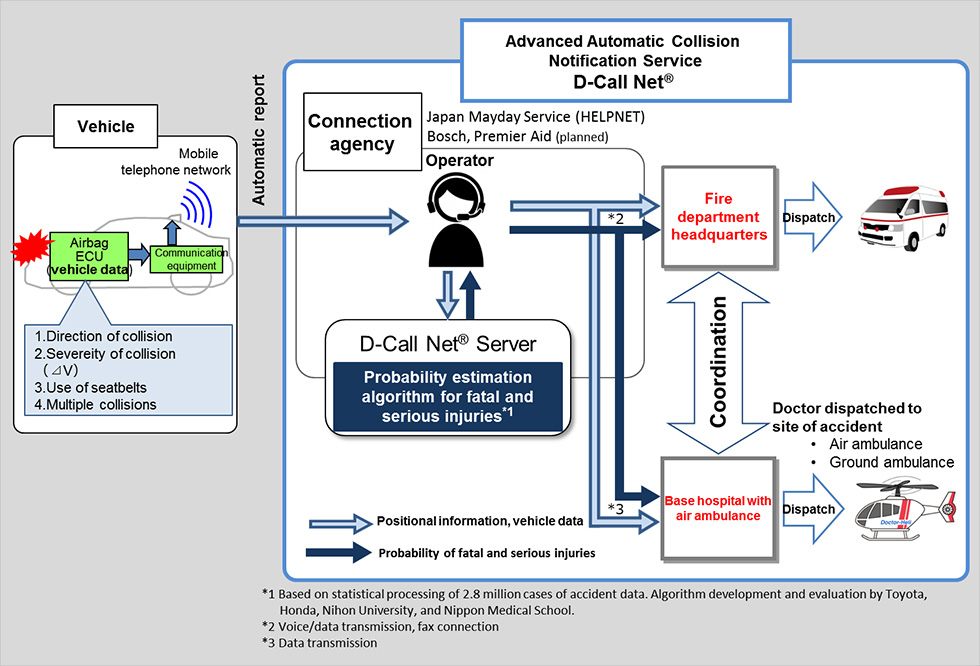
Honda Global | March 28, 2019 SUBARU, Nissan, and Mazda Vehicles to Be Newly Equipped with “D-Call Net®” Advanced Automatic Collision Notification System

A total of nine organizations, including HEM-Net, Toyota, Honda, HELPNET, Bosch, and Premier Aid will now promote D-Call Net® initiatives throughout Japan Tokyo, Japan, March 28, 2019—Three new automobile manufacturers—SUBARU, Nissan, and Mazda—are to participate in D-Call Net®, which comprises the certified non-profit organization Emergency Medical Network of Helicopter (HEM-Net), automobile manufacturers, and service providers.… Continue reading Honda Global | March 28, 2019 SUBARU, Nissan, and Mazda Vehicles to Be Newly Equipped with “D-Call Net®” Advanced Automatic Collision Notification System

The new BMW Group High Performance D3 platform. Data-Driven Development for Autonomous Driving.

Autonomous Driving at the BMW Group. It was back in 2000 when the BMW Group first started to conduct research into its vision of a car that people could drive themselves – but didn’t have to. Six years later, in 2006, a BMW was following the racing line around the Hockenheim circuit without human assistance… Continue reading The new BMW Group High Performance D3 platform. Data-Driven Development for Autonomous Driving.

Ford Restructures Russian Joint Venture to Grow Commercial Vehicle Business; Exiting Passenger Vehicle Market in Russia

Supporting Ford’s global redesign strategy to strengthen its leadership in commercial vehicles and growth in Europe, Ford and its partner, Sollers PJSC, confirm the restructuring of their Russian joint venture A restructured Ford Sollers will build on Ford Transit strength as Russia’s top-selling, non-domestic commercial vehicle nameplate and maintains a strong brand presence in the… Continue reading Ford Restructures Russian Joint Venture to Grow Commercial Vehicle Business; Exiting Passenger Vehicle Market in Russia