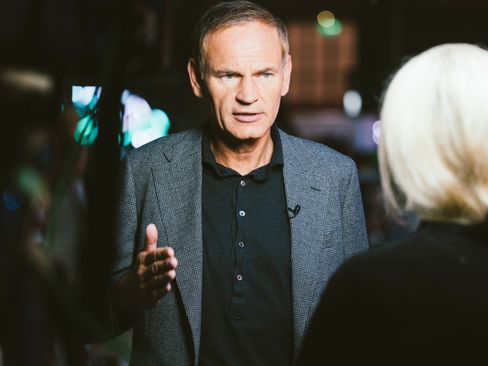
Dear reader,
Germany gets an electric car bonus again. Simply feeding old electricity into new charging cables is too easy for the federal government. For example, it incorporates a “social staggering” to prevent “windfall effects” for higher earners: only those whose taxable household income does not exceed 80,000 or 90,000 euros (families with children) can apply for funding.
But the Merz cabinet is also repeating some of the mistakes of the past. This means that used cars are once again left out of the funding. The used electric cars will inevitably lose value. The effort involved in applying is even increasing: anyone who wants subsidies has to provide more evidence than previous programs – starting with taxable income. A bureaucratic monster is looming.
In the past, the application was taken over for customers and the funding amount was temporarily financed until it was paid out, says car dealer Daniel Liliensiek (47). “That’s not possible with this program, but that’s exactly what customers will expect.”
Our topics of the week:
Why Volkswagen is afraid of the next software crash
Why Tesla’s investors are in for a rude awakening
Which is why the stars of numerous car designers are falling
Topic of the week: Volkswagen and the fear of the next software crash

Enlarge image
Rivian key project: Volkswagen boss Oliver Blume
Photo:
Daniel Delang / manager magazine
Herbert Diess (67) dreamed of transforming Volkswagen into the software dominator of the auto industry. He never found the right code for it. Successor Oliver Blume (57) took a different path; formed alliances – in China with several partners. For the rest of the world, Blume relies on Rivian. The first car that is supposed to take their software skills to another level is the VW ID.1. Announced for 2027 and a harbinger of Volkswagen’s planned catch-up. At least that’s Blume’s plan and expectation. Can this work well? And what if not? “If Rivian doesn’t work out, we can dig our grave,” a top manager quoted a company executive as saying. My colleague Michael Freitag reports exclusively: Even if the Volkswagen leadership sees the alliance on track – Fear of another bankruptcy is rampant in the company.
Heads: Gorden Wagener ++ Wolfgang Ufer ++ François Provost

Enlarge image
Call me “Prof. h. c. Dr. h. c. Dipl.-Des., Chief Design Officer”: Mercedes still head of design Gorden Wagener
Photo:
Mercedes Benz
Anyone looking for real free spirits in the Republic’s often rigid and immobile car companies should look out for the design centers of Mercedes, Audi or Volkswagen. If a sketch is successful, you quickly become a star in the company – with the license for many extravagances. But now, it seems, the cemented designer glory is crumbling. Klaus Zyciora (64; ex-VW), Marc Lichte (56; ex-Audi), most recently Gorden Wagener (57; ex-Mercedes) – numerous grandees at the pen had to pack their drawing cases. What is it about? My colleagues Margret Hucko and Franz Anko-Hubik write about the end of the design gods
.
The look of the current Smart model range no longer has anything in common with the once clearly recognizable design. But a two-seater is expected to return soon. Dirk Adelmann (47) fought for #2, but he will no longer actively support the resurrection himself. Instead, Smart’s European boss takes over responsibility for the Swiss market at Mercedes-Benz. His successor at Smart has already been determined; For the current head of Germany, Wolfgang Ufer, the motto is: off to new shores! We apologize for what is probably the worst pun in the history of this newsletter.
François Provost (57) also started a new job in the summer. As head of the car manufacturer Renault, he is busy. Ford will also use its own platform for small electric cars in the future. Now the French have arranged the next deal: together with the defense company Turgis Gaillard Renault will also build drones for Ukraine in the future.
Company: Tesla ++ Volkswagen ++ Porsche ++ Traton ++ Continental

Enlarge image
Master of hype: Tesla CEO Elon Musk is increasingly resorting to tricks to hide Tesla’s technical deficit
Illustration [KI]: Lisa Sheehan / Début Art / manager magazin; Photo [AI]: Kevin Mazur / Getty Images
The days when Tesla’s cars made venerable manufacturers look old and hardly venerable are long gone. Tesla has just sold fewer cars for the second year in a row, and its image has been tarnished by the escapades of company patron Elon Musk (54). Nevertheless, Tesla remains a high flyer on the stock market. Musk managed to rewrite the story. Instead of electric cars, it’s now about autonomous driving and Optimus robots. How much substance is there in fantasy? Tesla’s “Autopilot” has already caused numerous tragic accidents. And when it comes to humanoid robots, there are also doubts as to whether Musk can be at the forefront of development with his Optimus. My colleague Jonas Rest analyzes in detail in our cover story, why Tesla’s investors are threatened with a reality shock
.
One or two top executives at Volkswagen may have just suffered a moderate shock: Thomas Schäfer (55), head of volume products (“Brand Group Core”) in the group, is cutting every third board position at VW, Škoda, Seat/Cupra and Volkswagen Commercial Vehicles. In the future, the brands will no longer have their own board members for production, technical development and procurement. In production alone, the “synergetic control model” is intended to help to save one billion euros by 2030.
The new Porsche boss Michael Leiters (54) will also have to make a course correction. 2025 was a year to forget for the sports car manufacturer. Porsche’s sales shrank to around 279,400 vehicles, and things were particularly bad in China and Germany. Overall, the bottom line was a minus of 10 percent. It certainly won’t be easy, the Leiters Porsche polish.
Volkswagen’s commercial vehicle holding company Traton also had to make cuts in terms of sales and margins last year. The adjusted operating return, for example, fell from 9.2 percent in 2024 to 6.3 percent. The stock market nevertheless reacted with satisfaction.
Continental’s preliminary figures were less well received there. With an adjusted earnings margin of 10.2 percent, the supplier hit the lower end of the corridor that had been planned for 2025. However, the ContiTech industrial division is weakening at the wrong time. The group actually wants to get rid of this in order to concentrate solely on the tire business in the future.
If you have any questions or suggestions about this newsletter, please feel free to write to us manage.mobility@manager-magazin.de
. Of course, if you have any tips or suggestions for research. We look forward to your message.
Number of the week: 320

Enlarge image
Cuts in Koblenz: Canyon is also cutting positions at the headquarters
Photo: Patricia Kühfuss / manager magazin
Canyon has to cycle through a deep valley. After years of losses, founder Roman Arnold (62), who only returned in the summer, is now putting the brakes on: 320 of the 1,600 jobs worldwide at the bicycle manufacturer will be lost, and the headquarters in Koblenz will be hit particularly hard. Arnold also wants to streamline the model range and focus more on e-bikes, it is said. My colleague Lutz Reiche has more exclusive details about the savings shock at Canyon
.
Deepdrive: Car? Rather not

Enlarge image
Photo: manager magazine
Investors have recently been increasingly turning away from anything that says car on it. This is proven with hard numbers analysis
from AlixPartners. While the market for takeovers in the automotive sector in Europe was still stable between 2022 and 2024, it fell in 2025. 253 transactions represented a decrease of almost a quarter. “Traditional suppliers” in German-speaking countries find it particularly difficult to find buyers. Those who don’t have any future technologies such as battery technology or driver assistance systems often fail. Given the high number of bankruptcies in the industry, a takeover would be a lifeline for many companies; “However, there is a gap between supply and demand,” say the AlixPartners experts.
Ghost driver of the week

Enlarge image
“Idiot” and “complete idiot”: serial entrepreneur Elon Musk (l.) and Ryanair boss Michael O’Leary exchanged pleasantries
Photo: Alain JOCARD / AFP, Philip Reynaers / Photo News / IMAGO
Will Elon Musk blow up if things don’t work out with Optimus? Who knows. After an exchange of blows with Ryanair boss Michael O’Leary (64), Musk just let his X followers vote on whether whether he shouldn’t just buy the low-cost airline. One could consider it to be the usual Musk nonsense, but: The use of Twitter once started not so dissimilarly. Musk and O’Leary had a falling out over Starlink; the Ryanair boss doesn’t want to use Musk’s satellite internet service on his planes. His clients are not prepared to pay for it. And besides, Musk is rich, but an idiot. Musk countered that O’Leary was “a complete idiot.” Welcome to the lives of two medieval superegos.
I hope you get through the week without any major arguments.
Yours, Christoph Seyerlein
Do you have any wishes, suggestions or information that we should take care of journalistically? You can reach my colleagues in the Mobility team and me at manage.mobility@manager-magazin.de
.
You can also find our newsletter “manage:mobility”. here on our website.