Mercedes-Benz EQC, VW’s battery factory, Hyundai’s electric sports car: Today’s Car News

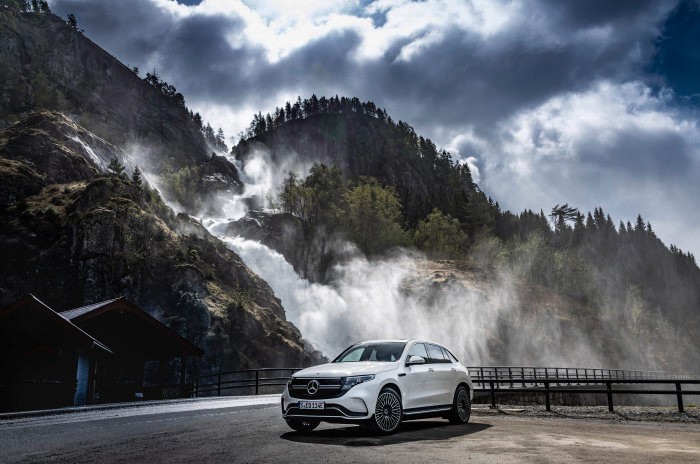
2020 Mercedes-Benz EQC 400 – first drive – Norway, May 2019
We're among the first to drive the Mercedes-Benz EQC. Volkswagen plans to invest $1.1 billion in a new battery factory in Germany. Hyundai and Kia invest $80 million in Croatian EV startup Rimac. And our Twitter poll asks how EV drivers should contribute to road maintenance. All this and more on Green Car Reports.

In a first drive outside of Oslo (practically native habitat for luxury electric cars), the new 2020 Mercedes-Benz EQC electric SUV proved itself among the quietest and most luxurious EVs we've driven. But solid range measurements remained elusive.

As VW and other German automakers are scrambling to build local battery supplies in Europe, the country's largest automaker announced plans to build a new battery factory—along with a partner—in its home state of Lower Saxony.

Korean auto giant Hyundai, along with its sister company Kia, gave Croatian EV sports-car startup Rimac a big boost in its bid to become a Tier 1 supplier of electric drivetrain components to the auto industry, with a big investment and plans for a new Korean electric sports car.

Our Twitter poll this week asks our readers how electric-car drivers should contribute to road maintenance, traditionally funded by state gas taxes.

Volkswagen also previewed a new digital dashboard for its upcoming 2020 redesign of the Golf.

Finally, the NHTSA will give up on new requirements, first adopted in light of the Toyota unintended acceleration problem in 2011, to require brake override software on new cars.

_______________________________________

Follow Green Car Reports on Facebook and Twitter

Volvo Car Group signs multi-billion dollars battery supply deals

SHANGHAI, May 15 (Xinhua) — Volvo Car Group announced on Wednesday that it signed long-term agreements with leading battery makers CATL and LG Chem to ensure the multi-billion dollars supply of lithium-ion batteries over the coming decade for next-generation Volvo and Polestar models.

The agreements cover the global supply of battery modules for all models on the upcoming SPA2 and the existing CMA modular vehicle platforms and represent a major step toward realizing Volvo Cars' ambitious electrification strategy.

In 2017, Volvo Cars made the commitment that all new Volvo cars launched from 2019 would be electrified. The company stated that it aims for fully electric cars to make up 50 percent of its global sales volume by 2025.

“The future of Volvo Cars is electric, and we are firmly committed to moving beyond the internal combustion engine,” said Håkan Samuelsson, president and CEO of Volvo Cars. “Today's agreements with CATL and LG Chem demonstrate how we will reach our..

Driving the 2020 Mercedes-Benz EQC All-Electric Luxury SUV

OSLO, Norway—We’re making our way back to the hotel after a rainy day of driving and otherwise being indoctrinated to the key elements of the all-new, all-electric 2020 Mercedes-Benz EQC 400 4Matic. As the traffic slows, we get a chance to glance at the cars passing by us on their way out of Oslo’s city… Continue reading Driving the 2020 Mercedes-Benz EQC All-Electric Luxury SUV

Tue 14 May 2019

Gordon Murray presents virtual exhibition of life's work

50 years of automotive design and engineering immortalised in online showcase

Fans can ‘sit’ in Senna’s Formula One car; examine detail of a McLaren F1

Free exhibit goes live in tandem with Murray’s One Formula book launch

Gordon Murray has unveiled a fully-immersive, internet-based virtual exhibition of 40 different iconic race and road cars produced during the past 50 years of his illustrious career in vehicle design and engineering. The online exhibition, which brings to life the private ‘One Formula’ exhibition held in late 2017, is free to access and can be found at www.oneformulagordonmurray.com.

Motorsport fans can ‘walk’ among cars driven by legends including Piquet, Senna and Prost, and even ‘sit’ in the cockpits for a driver’s-eye view. Among the grand prix cars featured are the Brabham BT46B ‘Fan Car’, the BT49C that won the 1981 World Drivers’ Championship in the hands of Nelson Piquet, and the McLaren MP4/4, which Ayrton Senna drove to his first Drivers’ Championship victory in 1988.

Visitors can also explore the McLaren F1 – still the world’s fastest naturally-aspirated road car, and its celebrated Le Mans racing siblings. Other famed Murray projects showcased include the OX flat pack truck, the TVR Griffith and the revolutionary iStream® platform manufacturing technologies.

Professor Gordon Murray, CBE, said: “It is such thrill to share my passion for engineering purity, beautiful design, aerodynamic excellence, and technological innovation. Creating an exhibition in a free-to-view format, accessible to all, in stunning virtual reality is exciting and a source of great pride.

“For the One Formula exhibition, we gathered almost every race and road car from my 50-year career to date, and we were inundated with requests from fans across the world who wanted to visit. Being a short-term, private exhibition meant we couldn’t share our passion with these enthusiasts. So, doing so in virtual form is the next best thing!”

The launch of the free virtual exhibition coincides with the launch of Murray’s ‘One Formula’ book, a two-volume, 900-page epic that charts in detail the ideas, personal perspectives, triumphs and records achieved over 50 years of automotive design and engineering.

Those who explore every corner of the detailed and fascinating online showcase will see information and exhibits covering the design, engineering, prototyping and development of vehicles by Gordon Murray Design Limited. By scrutinising the principles Murray has applied across his career, visitors may piece-together the blueprint for a forthcoming supercar – which is currently under top secret development.

-Ends-

Professor Gordon Murray, CBE – biography

Gordon Murray was born in Durban, South Africa in 1946 and gained a Mechanical Engineering Diploma from Natal Technical College. He designed, built and raced his own sports car (the IGM Ford) in the National Class in South Africa during 1967 and 1968.

In 1969 Gordon moved to the UK and joined the Brabham Formula One Team as Technical Director, winning two world championships (1981 and 1983) during his 17 years with the team. Gordon joined McLaren Racing as Technical Director in 1988 and three consecutive championship wins (1988, 1989 and 1990) followed. In 1990, Gordon moved away from Formula One – after 50 Grand Prix wins – to concentrate on establishing a new company for the group, McLaren Cars Limited.

The company’s first project, the F1 road car, is still regarded as one of the world’s best engineered cars. A racing version won two world sports car championships and the Le Mans 24-hour race on its first attempt in 1995. McLaren Cars then completed several other successful projects culminating in the Mercedes-Benz SLR McLaren programme.

Gordon left McLaren in 2005 to set up his new company Gordon Murray Design Limited (in 2007), of which he is CEO and Technical Director. The innovative British company operates from Shalford in Surrey, and aims to be the world leader in automotive design. It reverses the current industry trend for sub-contracting by having a complete in-house capability for design, prototyping and development.

In 2017, Gordon Murray Design celebrated the company’s 10-year anniversary along with that of the iStream® manufacturing process. At a special event, named ‘One Formula’ Gordon Murray also celebrated the 25th anniversary of the McLaren F1 road car entering production, and his 50th year of car design and engineering.

In May 2019, Professor Murray was made a Commander of the British Empire (CBE) by the Duke of Cambridge, Prince William. The ceremony, held at Buckingham Palace, recognised the contributions made by Murray to the motorsport and automotive sectors over the past 50 years.

PR contacts

For further information, images or comment about the Gordon Murray Group, please contact:

Jon Visscher

PFPR Communications

Jon.Visscher@pfpr.com

01622 776 680 / 07816 906 794

Sarah Smith, Communications Officer

Gordon Murray Design

sarah.smith@gordonmurraydesign.com

01483 484 710

Virtual exhibition by Insight Simulation

Contact David Hothersall

david@insightsimulation.com

www.insightsimulation.com

DOWNLOADSDownload Release

ChargePoint sounds alarm on electric vehicle charging standards – Reuters UK

FRANKFURT (Reuters) – A leading operator of charging stations has sounded the alarm on a proposed technical standard that it says could hamper mass adoption of electric vehicles by making it harder to charge them at home or at work. FILE PHOTO: A ChargePoint station on display at the Frankfurt Motor Show (IAA) in Frankfurt,… Continue reading ChargePoint sounds alarm on electric vehicle charging standards – Reuters UK

The Mercedes-Benz EQC: Electric Intelligence

15.

May 2019

Oslo

EQC (electricity consumption combined: 20.8 – 19.7 kWh/100 km; CO2 emissions combined: 0 g/km)* ; *Electric energy consumption and range have been determined on the basis of Regulation (EC) No. 692/2008. Electric energy consumption and range depend on the vehicle configuration.Oslo. The new Mercedes-Benz EQC (combined power consumption: 20.8 – 19.7 kWh/100 km; combined CO2 emissions: 0 g/km)[1] is the first Mercedes-Benz under the product and technology brand EQ. At the press driving presentation in Oslo, the European “capital of e-mobility”, the EQC is dynamically demonstrating its all-round qualities for the first time. It systematically embodies the principle of “human-centred innovation”, and makes e-mobility simple, reliable and convenient for the customer. The EQC combines the know-how from more than 130 years of automobile engineering with the mobility requirements of the future, and stands for Electric Intelligence.
“The Mercedes-Benz EQC is not just a vehicle with electric drive, it combines hallmark attributes of the brand such as quality, safety and comfort. Its progressive design, unique driving comfort and an operating range absolutely suitable for day-to-day needs emphasise that the EQC is the Mercedes among electric vehicles. This is also shown by its services – from optimised navigation to charging management. It all comes under the heading “Electric Intelligence” – a mobility package that goes well beyond the vehicle itself,” says Britta Seeger, member of the Board of Management of Daimler AG responsible for Mercedes-Benz Cars Sales.
Optimum planning before a journey
Individual services relating to e-mobility have been around for a while. The EQC takes a new, comprehensive approach: the intelligent networking of services and functions considerably simplifies use of the vehicle. With its intelligently coordinated drive system, battery management, charging management, recuperation strategies, digital services and the infotainment system MBUX, the EQC is a new departure in e-mobility.
The experience already begins before the journey. EQC drivers can plan their destinations from the home or office, enter a departure time and bring the interior to the desired temperature. They receive an intelligently planned route including necessary charging stops and an arrival time. On request they can receive a push notification when the charging process starts and ends. This creates transparency and helps drivers to plan upcoming journeys to best effect. Programming is possible directly via MBUX – Mercedes-Benz User Experience or via the Mercedes me App.
Intelligent navigation – more than just from A to B
The vehicle's electric intelligence is also shown in for the EQC optimised navigation. It uses numerous factors to plan a route automatically – including loading stops if necessary. It takes into account e.g. the current charge status of the battery, the weather, the topography and traffic flow, and available charging stations. The route calculation is always based on a fast and convenient route with few charging stops and short charging times – therefore quick-charging stations are given preference. Customers do not necessarily have to charge the vehicle fully, but can charge it to suit the total journey time. The route planning also responds dynamically to changes. It can take place both offboard and onboard, i.e. externally (via the Mercedes me App) and within the vehicle. The journey can therefore be conveniently planned at home before departure, or while already en route if required. The voice control specific to the Mercedes-Benz EQC makes operating the EQC easier – thanks to natural language recognition. It is activated by the key words “Hey Mercedes”. This is because the LINGUATRONIC of MBUX recognises and understands many questions and commands relating to electric car specific control aspects. A few examples: “Show me the energy flow”, “What charging settings have been made?”, “Charge the vehicle to 85 percent” or “Where is the nearest charging station?”.
Via Mercedes me Charge the customer receives access to the world's largest charging net with over 300,000 charging points and over different operators of public charging stations in Europe alone (municipalities, carparks, motorways, shopping centres, etc.). Thanks to EQC-optimised navigation, Mercedes-Benz customers can find these stations easily and can gain convenient access to the charging stations via the Mercedes me Charge card, the Mercedes me App or directly from the car. No separate contracts are necessary for this: apart from authentification, customers benefit from an integrated payment function with simple billing. The customer chooses the preferred payment method only once. Every charging procedure is debited automatically. The individual charging processes are clearly listed in a monthly invoice.
Mercedes me Charge also allows access to the quick-charging stations of the pan-European network IONITY. Especially over long distances, the short charging times make for a pleasant journey. By 2020 IONITY will construct and operate around 400 quick-charging stations along the main traffic arteries in Europe. IONITY was founded in November 2017 as a joint venture by BMW Group, Daimler AG, Ford Motor Company and the Volkswagen group with Audi and Porsche.
Tailor-made drive system for efficiency and dynamics
To exploit the advantages of locally emission-free electric drive to the full, the developers of the first Mercedes-Benz vehicle under the new product and technology brand EQ decided on a completely newly developed drive system with intelligent control. Both the electric powertrains (eATS) and the battery were tailor-made for the Mercedes-Benz EQC. Tractive power is provided by an asynchronous motor at each axle. The asynchronous motors generate an output of 300 kW and a maximum combined torque of 760 Nm. The electric motor, a fixed-ratio transmission with a differential, the cooling system and the power electronics form a highly integrated, very compact unit.
The compact electric powertrains (eATS) at the front and rear axles give the EQC the driving characteristics of an all-wheel drive. Intelligent control allows dynamic torque distribution between the two driven axles over a wide operating range, creating the conditions for high driving dynamics. Torque shifting allows the torque to be distributed dynamically between the front and rear axles, ensuring that there is always a satisfying balance between power and efficiency.
To reduce power consumption and increase dynamism, the electric drivetrains are configured differently: the front electric motor is configured for best possible efficiency in the low to medium load range, while the rear one determines dynamism.
The battery: powerful energy pack from in-house production
The centrepiece of the Mercedes-Benz EQC is the lithium-ion battery arranged in the vehicle floor. With an energy content of 80 kWh (NEDC)[2], it employs a sophisticated operating strategy to supply the vehicle with power, enabling an electric range of 445 – 471 km (NEDC)2.
The latest-generation lithium-ion battery consists of 384 cells and is located in the vehicle floor, between the two axles. The battery system is modular in design, consisting of two modules with 48 cells each and four with 72 cells each. The powerful high-voltage battery has a maximum voltage of 405 V and a nominal capacity of 230 Ah.
The entire battery system is liquid-cooled. At low temperatures a battery heater ensures outstanding performance and efficiency, especially while charging. The battery is an integral part of the crash concept for the vehicle as a whole. Its low, central location also has a positive effect on the handling characteristics of the EQC. The battery is produced in Germany, by the wholly-owned Daimler subsidiary Deutsche ACCUMOTIVE in Kamenz/Saxony.
Intelligent recuperation and assistants for good progress
To ensure that the technical operating range is used to the maximum, the Mercedes-Benz EQC also charges its batteries when on the move. On the overrun or when braking, the mechanical rotation is converted into electrical energy and used to charge the high-voltage battery (recuperation). During this process, both electric motors are used as generators. This achieves the maximum recuperative deceleration.
The driver has a major influence on recuperation. He/she is also able to influence the recuperation level using so-called paddles behind the steering wheel. The paddle on the left increases the level of recuperation, the paddle on the right reduces it. The following stages are available:
D Auto (recuperation via ECO Assist to suit the situation) D + (coasting) D (low recuperation) D – (medium recuperation) D – – (high recuperation) This makes one-pedal driving possible, because in most situations the recuperative deceleration is enough not to require operation of the brake pedal. The ECO Assist assistance system is a particularly intelligent tool that helps drivers to achieve maximum efficiency. Following the maxim of “predictive driving for economy”, navigation data, traffic sign recognition and information from the intelligent safety assistants (radar and stereo camera) are networked. The ECO Assist assistance system comprehensively supports drivers in implementing this effective efficiency strategy: by prompting the driver when it is appropriate to come off the accelerator, e.g. because the vehicle is approaching a speed limit, and by functions such as coasting and specific control of recuperation.
In combination with EQC-optimised navigation, active range monitoring ensures that the driver reaches the destination even if a charging stop is missed. The driver receives additional support in the Max Range driving mode, which was specially developed for the Mercedes-Benz EQC. In this mode the driver is encouraged to keep to the speed limit by a haptic accelerator pressure point, so that the next charging point or the destination is reached.
ECO Assist takes the following traffic situations and information into account in its driving recommendations and efficiency strategy: route profile (bends, junctions, roundabouts, gradients), speed limits and the distance from vehicles travelling ahead.The power consumption and range of electric vehicles greatly depend on the driving style. The EQC supports its driver with driving modes that have different characteristics.[3] In the more economical driving modes, the haptic accelerator pedal that prompts the driver to conserve power plays an important role.
Strategic driving for longer range
The power consumption and range of electric vehicles greatly depend on the driving style. The EQC supports its driver with driving modes that have different characteristics.[1] In the more economical driving modes, the haptic accelerator pedal that prompts the driver to conserve power plays an important role.
The following programs are available:
COMFORT: Default setting; accelerator pedal characteristic supports a comfortable driving style, but also automatically becomes more dynamic depending on the driving style. ECO: Driving program focused on high efficiency and low consumption. MAX RANGE: Intelligent driving program that can help the driver achieve the maximum possible range. SPORT: Driving program focused on the best response for the highest driving performance. INDIVIDUAL: There is also an individual driving program which allows the various parameters to be adjusted separately. Efficient charge management
Whether at home via a wallbox, while shopping, at work or particularly fast on the motorway: there are various ways to supply electric vehicles with power. Intelligently networked charging solutions focussed on the mobility and convenience needs of customers are an integral part of the new product and technology brand EQ.
As standard the EQC is equipped with a water-cooled onboard charger (OBC) with a capacity of 7.4 kW, making it suitable for AC charging at home or at public charging stations. The charging time required for a full charge depends on the available infrastructure and the country-specific vehicle equipment.
It is faster still with DC charging – which is standard for the EQC – for example via CCS (Combined Charging Systems) in Europe and the USA, CHAdeMO in Japan or GB/T in China. This usually public quick-charging system expands the existing technical standard for AC charging of electric vehicles with the capacity for DC fast charging. Depending on the SoC (state of charge) the EQC can be charged with a maximum output of up to 110 kW at an appropriate charging station. In around 40 minutes, the battery can be charged from 10 – 80 percent SoC.[4]
The EQC can be charged at a domestic power socket, but with the Mercedes-Benz Wallbox Home, all battery-electric vehicles and plug-in hybrids by Mercedes-Benz can be charged much faster than from a domestic socket. The Mercedes-Benz Wallbox Home is a charging station that allows fast, safe and convenient recharging at home.
In cooperation with a country-specific charger installation partner, Mercedes-Benz also offers easy and rapid installation of the Mercedes-Benz Wallbox and professional advice on all aspects of e-mobility.
Long-term worry-free vehicle usage
Also available for the Mercedes-Benz EQC are optional, customer-friendly e-mobility services, which ensure long-term worry-free vehicle usage. These include the optional service packages “Maintenance Service”, “Pick-up & Delivery Service” and “Vehicle Warranty Extension”, as well as the “Wearing Parts Package”, which are already available on vehicle purchase.[5]
The “Maintenance Service” comprises all required maintenance work for a period of up to six years or a mileage of 150,000 kilometres. Special attention is paid to checking safety-relevant parts and checking the functionality of electrical components. Use of Mercedes-Benz GenuineParts and special tools ensures a smooth and reliable driving experience.
In combination with the “Maintenance Service”, the “Pick-up & Delivery Service” makes planning workshop visits as convenient as possible. The Mercedes-Benz EQC will be collected for maintenance work over a period of six years (or up to six times) and will also be returned upon the customer's request. This service is available from the customer's home, from the office or from any other place within a defined radius around an authorised Mercedes-Benz workshop.
The service package “Vehicle Warranty Extension” protects the vehicle owner against unexpected repair costs beyond the standard Mercedes-Benz new car warranty[6] up to a vehicle age of six years. The extension of the vehicle warranty is the optimal addition to the standard EQC battery certificate for the high-voltage battery, which is valid for eight years or 160,000 kilometres. It guarantees a properly functioning high-voltage battery and also covers significant capacity loss.
The “Wearing Parts Package” includes replacement of important wearing parts such as brake linings, brake discs or wiper blades for a period of up to six years. This supports high value retention for the Mercedes-Benz EQC, and a high level of cost certainty.
All of the service packages are bound to the vehicle for a period of six years and are transferred to subsequent owners in case the vehicle is sold. This additionally contributes to the vehicle's value retention.
In time for the Mercedes-Benz EQC launch there will be a “Holiday Mobility Package” available for customers in Germany[7]. Through access to a Mercedes-Benz rental vehicle with a traditional combustion engine, the customer will be able to travel further distances on holiday in areas that do not yet have sufficient charging infrastructure.
With the Holiday Mobility Package the customer receives a specific “mobility budget” for the premium rental service Mercedes-Benz Rent. This will give access to the full range of Mercedes-Benz products, from a convertible for a summer weekend break, through to the V-Class for a family holiday. The mobility package will be simple to redeem at Mercedes-Benz EQ partners, tailored according to individual needs and with the customary Mercedes-Benz Rent premium service. EQC customers will benefit from a price advantage of around 10% compared to regular Mercedes-Benz rental fees.
Technical data
CO2 emissions
0 g/km
Power consumption (NEDC)
20.8 – 19.7 kWh/100 km)[8]
Range (NEDC)
445 – 471 km8
Charging time at a Wallbox or at public charging stations (AC charging)
11 hrs.[9]
Charging time at a quick-charging station (DC charging)
approx. 40 min.[10]
Drive system
2 asynchronous motors, all-wheel drive
Output
300 kW (408 hp)
Peak torque
760 Nm
Top speed
180 km/h (governed)
Acceleration 0-100 km/h
5.1 s
Battery
Lithium-ion
Battery energy content (NEDC)
80 kWh8
Battery weight
652 kg
Length/width (incl. mirrors)/height
4,761/1,884 (2,096) /1,623 mm
Track width (FA/RA)
1,625/1,615 mm
Wheelbase
2,873 mm
Luggage compartment (depending on equipment fitted)
approx. 500 l
Kerb weight (EC)/perm. gross vehicle weight/payload (EC)
2,495/2,940/445 kg
Perm. trailer load for 12% uphill gradient
1,800 kg
[1] Power consumption and range have been determined on the basis of Regulation (EC) No. 692/2008. Power consumption and range depend on the vehicle configuration.
[2] Power consumption and range have been determined on the basis of Regulation (EC) No. 692/2008. Power consumption and range depend on the vehicle configuration.
[3] This package applies to Germany and the European markets, and may vary in other countries.
[4] The charging times are for 10-80% full charge when using a DC rapid charging station with supply voltage 400 V, current at least 300A.
[5] This package applies to Germany and the European markets, and may vary in other countries.
[6] The exact conditions of the “vehicle guarantee extension” are to be found in the respective general terms and conditions for each country when purchasing the vehicle.
[7] In other European countries, country-specific mobility solutions are being planned for EQC customers. These will be announced at a later date.
[8] Power consumption and range have been determined on the basis of Regulation (EC) No. 692/2008. Power consumption and range depend on the vehicle configuration.
[9] The charging times are for 10-100% full charge when using a Wallbox or public charging station (AC connection with at least 7.4 kW, 16A per phase)
[10] The charging times are for 10-80% full charge when using a DC rapid charging station with supply voltage 400 V, current at least 300A.

Press Contact

Koert Groeneveld

Head of International Product & Technology Communications

koert.groeneveld@daimler.com

Tel: +49 711 17-92311

Fax: +49 711 17-94365

Wolfgang Würth

Manager Communications EQ

wolfgang.wuerth@daimler.com

Tel: +49 711 17-46508

Fax: +49 711 17-79016071

Press Contact Overview

Media

Download

Pictures (38)

Videos (4)

Documents (5)

Media Contact (2)

Filter

Show thumbnails
Show list
Slideshow

Zoom

Preview

Details

Do you really want to delete the data record?

Please wait a moment …

Please wait a moment …

Please wait a moment …

Please wait a moment …

19C0331_014

19C0331_037

19C0331_060

19C0331_062

19C0331_069

19C0338_001

19C0338_003

19C0338_006

19C0338_103

19C0338_107

19C0338_114

19C0332_001

19C0332_007

19C0332_021

19C0332_033

19C0333_004

19C0333_009

19C0333_012

19C0333_024

19C0333_043

19C0333_091

19C0333_093

19C0333_106

19C0334_006

19C0334_007

19C0334_012

19C0334_013

19C0334_019

19C0334_032

19C0334_038

19C0334_057

19C0334_061

19C0334_069

19C0334_087

19C0334_095

19C0334_099

19C0338_007

19C0333_010

Loading

Volkswagen wins worker backing for restructuring with $1.1 billion battery plan

BERLIN (Reuters) – Volkswagen workers backed a restructuring of the world’s largest carmaker on Tuesday after Chief Executive Herbert Diess pledged to spend 1 billion euros ($1.1 billion) on a new battery cell production plant near its headquarters in Lower Saxony. Volkswagen’s CEO Herbert Diess speaks ahead of Volkswagen Group’s annual general meeting in Berlin,… Continue reading Volkswagen wins worker backing for restructuring with $1.1 billion battery plan

Daimler’s CEO designate will push alliances to cut costs

Kaellenius said Daimler had moved from using an equal amount of nickel, cobalt and manganese in its electric car batteries, towards a new ratio of 8:1:1. Germany: Daimler will cut development costs of new Mercedes-Benz cars by a significant amount by 2025 and will intensify alliances with rivals as a way to improve margins, Ola… Continue reading Daimler’s CEO designate will push alliances to cut costs

Porsche fined $600 million in Germany over dirty diesels

2013 Porsche Cayenne Diesel
German regulators Tuesday hit Porsche with a $600 million (535 million euro) fine, for its role in selling cars powered by diesel engines designed by Audi that failed to comply with European emissions requirements.

The cars, including the Cayenne and Panamera, used a 3.0-liter diesel V-6, exceeded European emissions standards for oxides of nitrogen, which contribute to smog.

READ THIS: Audi to pay $927 million fine over diesel scandal in Germany

An investigation the regulators conducted found that Porsche employees turned a blind eye to the emissions cheating starting in 2009. In a release announcing the fine, Porsche emphasized that investigators found the negligence “several levels below” executive positions.

The fine represents the last action against Porsche, and one of the last against VW, to close out the legal repercussions of the larger VW emissions cheating scandal. In September, Porsche announced that it will stop selling diesels altogether as it focuses on developing and selling new electric models such as the new Taycan electric performance sedan due out late this year.

READ MORE: German prosecutors find collusion between automakers over diesel emissions

Audi was fined 800 million euros (about $927 million) last October over its leading role in the diesel emissions cheating scandal, and last month in a separate case triggered by the ongoing diesel emissions investigations, European Union regulators found that German automakers colluded to withhold the most effective emissions control systems from European consumers.

Daimler, which builds Mercedes-Benz models, does not expect to be fined in that case, because it drew European investigators' attention to the issue. BMW says it will fight the charges in court but set aside $1.1 billion in case it needs to pay the fine.

Tesla faces twin assault as Mercedes, VW start taking orders for first long-range EVs

Elon MuskMike Blake | ReutersIt's been a tough month for Tesla, and the challenges the Silicon Valley electric-car maker faces will only accelerate now that two major European automakers are launching sales of their first entries into the long-range EV market.
Volkswagen and Mercedes-Benz began taking orders Wednesday and Thursday, respectively, for new battery-electric vehicles, with the two companies each planning to follow up with a wave of additional entries over the next few years. Whether they will prove to be “Tesla killers,” as some observers have dubbed them, is far from certain but the two German manufacturers are each investing billions of euros in their electrification programs.
VIDEO1:3501:35Tesla has new competitor from AudiThe Bottom Line “With the Mercedes-Benz EQC, we are entering a new era of mobility,” said Britta Seeger, member of the board of management of Daimler responsible for Mercedes-Benz cars sales. “It is part of the growing family of all-electric vehicles at Mercedes-Benz and combines brand-defining features such as quality, safety and comfort.”
But one of the keys to success Seeger added, is likely to be longer “range absolutely suitable for everyday use.”
The Mercedes Benz EQC.Adam Jeffery | CNBCThe first wave of electric vehicles, such as the Nissan Leaf and Ford Focus Electric, could deliver only around 100 miles per charge. Tesla proved an immediate breakout with its Model S sedan yielding more than double that – and its latest version of that sedan is EPA-rated at 370 miles between charges.
The compact Mercedes EQC, essentially an electrified version of its GLC crossover, will get around 270 miles in European trim and even more in the version slated for the U.S. market.
Volkswagen's first long-range entry, the ID.3, lifts a page from Tesla's playbook by offering customers three different battery pack options. The smallest, at 45 kilowatt-hours, is expected to manage around 200 miles, based on European testing, with optional 58 and 77 kWh battery packs rated at around 260 and 340 miles, respectively.
The new VW hatchback hasn't even had its official world premiere — expected to take place at the Frankfurt Motor Show next autumn — and it will be about a year before the first customers can take delivery. But the automaker on Thursday opened up a special website for advance orders. Pricing for the ID.3, which initially will target the European market, will start at 30,000 euros ($34,000). Customers in Europe preordered 10,000 ID.3s in the first 24 hours on the market there, overwhelming the company's website and leading to long wait times online, VW said.
A Volkswagen ID 3 electric car is seen in a glass cage during a press conference in Berlin on May 8, 2019.ODD ANDERSEN | AFP | Getty ImagesThe crossover, which will anchor a new sub-brand dubbed Volkswagen ID, will be just the first in a broad array of about 50 long-range electric vehicles the Wolfsburg, Germany-based carmaker plans to bring to the market by mid-decade through its various brands. It has already launched sales of the new Audi e-tron crossover and is preparing to deliver the first Porsche Taycan battery sports cars.
For the U.S., VW will begin its electrified assault next year with a production version of the ID Crozz concept. In January, during a visit to the North American International Auto Show in Detroit, Volkswagen Chief Executive Officer Herbert Diess said his company will spend $800 million to expand its factory in Chattanooga, Tennessee, to handle that crossover and another all-electric model, a move that also will create about 1,000 new jobs.
“The supertanker is picking up speed,” Volkswagen executives said during a March presentation in Frankfurt. “We are aligning Volkswagen with e-mobility like no other company in our industry.”
Adam Jeffery | CNBCAdam Jeffery | CNBCVolkswagen's diesel emissions scandal has already cost it around $30 billion and seen a number of executives jailed or indicted, including former CEO Martin Winterkorn. The company's shifting its focus from the “oil-burners” that long dominated its lineup to focus on electrification.
It has announced plans to spend 9 billion euros, about $10 billion at current exchange rates, on battery cars by 2023. And during his Frankfurt speech, Diess upped his estimate of VW's global EV salesprojections from 15 million vehicles to 22 million over the next decade.
These numbers dwarf those of Daimler, but the parent of the Mercedes-Benz and Smart brands is making a similarly aggressive push relative to its size.
“We are going to launch 10 pure battery-electric vehicles until the end of 2022, and we are covering the whole portfolio — from Smart [cars] to big SUVs and big sedans,” board member Wilko Stark announced during a news conference at the Paris Motor Show in September.
The Mercedes Benz EQC.Adam Jeffery | CNBCThe new Mercedes EQC will go on sale in Europe first and then follow with an American market launch sometime next year, officials said during last month's New York International Auto Show. The event saw the debut of the EQC Edition 1886, a special launch version referencing the year when the founders of what is now Daimler patented the world's first vehicle to use an internal combustion engine.
The EQC Edition 1886 is promised to deliver 292 miles per charge and, with an output of 402 horsepower and 564 pound-feet of torque, it will launch from 0 to 60 in less than five seconds. Those numbers suggest it will pose a direct challenge to both Tesla's older Model X and upcoming Model Y.
While Mercedes-Benz and Volkswagen are just putting their battery-car programs into motion, BMW is preparing its own ramp-up. It currently offers an all-electric city car, the i3, through a special sub-brand, though that model doesn't match the range of what can be thought of as second-generation BEVs.
A new BMW i3 electric car is seen on the assembly line at the BMW factory in Leipzig, Germany.Getty ImagesFuture long-range products will more directly target Tesla, as well as Mercedes and VW. The Bavarian automaker recently confirmed plans to migrate to new vehicle platforms that will allow it to offer all-electric versions of virtually every model in its lineup.
Jaguar Land Rover was actually the first European automaker to enter the long-range space, its Jaguar I-Pace last month being named World Car of the Year by an international panel of motoring journalists.
But the wave of new products will soon turn into a tsunami. According to InsideEVs, a website devoted to electrification, 14 new battery cars will land in the U.S. market in 2020, with even more coming to Europe and China — the latter market encouraging the buildup with tough new energy vehicle regulations enacted in late 2017.
Ian Callum and the Jaguar I-Pace accept the award for the 2019 World Car Award at the New York Auto Show in New York on April 17th, 2019.Adam Jeffery | CNBCThe big question is whether consumers will accept the new offerings. A study released by AAA on Thursday found that only about 16% of U.S. motorists surveyed are definitely considering battery power for their next vehicle.
Last year, all forms of battery-based vehicles, including conventional hybrids, plug-ins and battery-electric vehicles, accounted for barely 5% of the American market. But BEV sales, in particular, roughly doubled.
That said, virtually all the growth could be accounted for by Tesla's new Model 3 sedan. Demand for competing long-range offerings like the Chevrolet Bolt EV and Jaguar I-Pace did grow, but at a much slower pace.
Manufacturers such as Mercedes and Volkswagen will have to hope more buyers start to plug in. The good news for them is that AAA found 40 million U.S. motorists would at least consider a BEV in the future, with millennials particularly open. And the long-standing axiom in the auto industry is that the more product available, the bigger the appeal.
Paul Eisenstein is a freelancer for CNBC. His travel and lodging to the New York auto show was paid for by an automaker.