Beyond Tesla, electric cars lose value faster than other vehicles

Lower maintenance and repair needs plus lower energy costs can make a very convincing case for electric car ownership.

The same isn’t always true for those who own vehicles the old-fashioned way, going with what’s new and fresh every three years or so, before trading it in for the next. Then, electric vehicles have an issue that can turn the math on its side: appalling resale value.

The average new electric vehicle loses 56.6 percent of its original value in three years, according to the car-deal search engine iSeeCars. The average among all kinds of vehicles is 38.2 percent of depreciation over three years.

The depreciation is from its sticker price, so it doesn’t include things like a potential EV tax credit of up to $7,500—which not every buyer may be able to claim.

In a recent analysis, iSeeCars found that the Fiat 500e had the steepest value plunge among EVs. Its average three-year-old used price was just $10,358—a depreciation of nearly 70 percent from its original price. The BMW i3 after three years cost just $19,784, which was a 63-percent cut from its original price. The Nissan Leaf (despite hints of an uptick last year) and Volkswagen e-Golf also posted steep value losses of nearly 60 percent over three years.

2018 BMW i3s

The Ford Fusion Energi was also called out by iSeeCars a plunge in value that was nearly as steep as that of those EVs. The Fusion Energi is worth just $15,983 after three years.

The new trends come from an analysis of more than 4.8 million car sales, comparing average price weighted by sales volume for vehicles sold between January and May 2019 with those of the same model sold between January and May 2019, adjusting for inflation via the U.S. Bureau of Labor Statistics.

2019 Tesla Model S

Tesla is an exception to the rule, though—and proof that EVs don’t have to be resale-value money pits. After three years, the average Tesla Model S remains worth a strong $57,517, according to iSeeCars, which is just a 17.1-percent reduction from its price when new.

For nearly all the other non-Tesla models, these losses help enforce the value of leasing (under what are in many case highly subsidized offers), while purchasing may only make sense when planning to keep an EV over a longer timeline.

All of the electric models that lost the largest chunk of their original value are short-range models. One of the keys to success (and a signal of success) for the new long-range fully electric vehicles is that they escape the pull of strong depreciation. With the first Chevrolet Bolt EVs due to near that three-year mark early next year—and the new ones in their tax-credit phaseout—we’ll start getting some answers on whether that's the case in a matter of months.

Cars: Until the VW robot car it takes “a few more days”

Volkswagen has created a new board position: the software board. He sees the autonomous driving still in the distance. June 18, 2019, 7:45 am, Andreas Donath Volkswagen does not expect a quick break in autonomous driving (Image: Pexels /CC0 1.0) Tesla boss Elon Musk thinks autonomous driving is still in to be able to offer… Continue reading Cars: Until the VW robot car it takes “a few more days”

Why it did not work between Aurora and VW

Why did the startup Aurora and the manufacturer Volkswagen separate? Aurora In recent years, the media attention has often surfaced, mainly because of the many cooperation agreements. Autonomous parking of VW. Source: VW Aurora was founded by former professionals of Google (Chris Urmson), Tesla and Over founded and focuses on the provision of autonomous driving… Continue reading Why it did not work between Aurora and VW

Why Electric Cars Are Better

Top Posts

Tesla, Convenience and a Jeda Wireless Pad V2

Why Electric Cars Are Better

How To Charge An Electric Car

Tesla’s Various Partnerships With Governments, Subsidies, & Regulatory…

Consumer Reports Owner Respondents Rank Tesla Model 3…

CATL and Honda signed cooperation agreement to supply…

Deloitte EV Sales Forecast Riddled With Errors

Should You Consider an E-Bike Instead of an…

BMW Unleashes The iNext Electric & Autonomous SUV…

This Holiday, Gift Yourself (or someone else) a…

GM’s Mary Barra stands by Cruise’s cautious strategy amid Tesla’s full self-driving push – Teslarati

By Simon Alvarez Posted on June 17, 2019 A recent interview with GM CEO Mary Barra from Axios has provided some of the executive’s insights about full self-driving solutions, competition from Tesla, and the Detroit-based company’s strategy for the deployment of its autonomous driving tech. Barra proved conservative, emphasizing that GM will not deploy its… Continue reading GM’s Mary Barra stands by Cruise’s cautious strategy amid Tesla’s full self-driving push – Teslarati

Tesla Quietly Discontinues the Model 3 Long Range With Rear-Wheel Drive

autoevolution

cars
moto
news
car reviews
spyshots
driven cars
space junk
green
newspaper

Compare Cars
BAC Calculator
Editorial
Coverstory
Motorsport
Testdrives archive
Auto Shows
Tuning
Car Finder
Photo of the Day
Glossary of automotive terms

Masthead
RSS Feeds

More on this:1 James May’s Next Car Could Be A Tesla Model 32 Tesla Model 3 Driver Sound Asleep at the Wheel, as Car Speeds Down Cali Highway3 Tesla’s Sentry Mode Scares Off Car Thief, Is Modern-Day Superhero4 New Tesla Model S Rendered With Sporty Exterior Ahead of Rumored Debut5 Tesla Model 3 Sentry Mode Catches Vandal Dousing Car With Acid

Space Junk

Mars Helicopter Readies Blades for Historic Mission

Tesla Quietly Discontinues the Model 3 Long Range With Rear-Wheel Drive

17 Jun 2019, 18:26 UTC ·
by Mircea Panait

Home > News > Car Profile

Once again, Tesla shocks the Model 3 community with a change that doesn’t make sense. The Long Range with rear-wheel drive is no longer available to order, one of the best propositions in the lineup.
8 photos
Customers on a budget are treated to the Model 3 Standard Range Plus with rear wheel drive, and that’s a bit of a shame if you remember that Tesla no longer offers the Model 3 Standard Range online. As a consequence of these changes, only the Long Range and Performance are available with all-wheel drive.
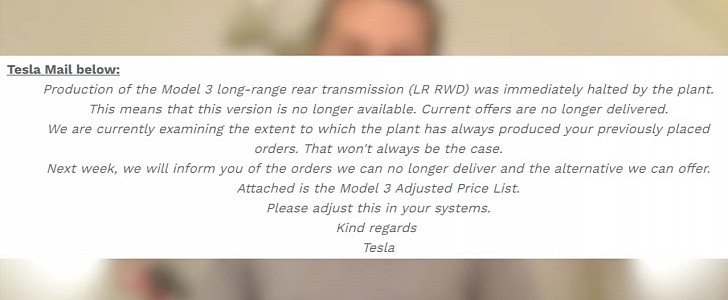
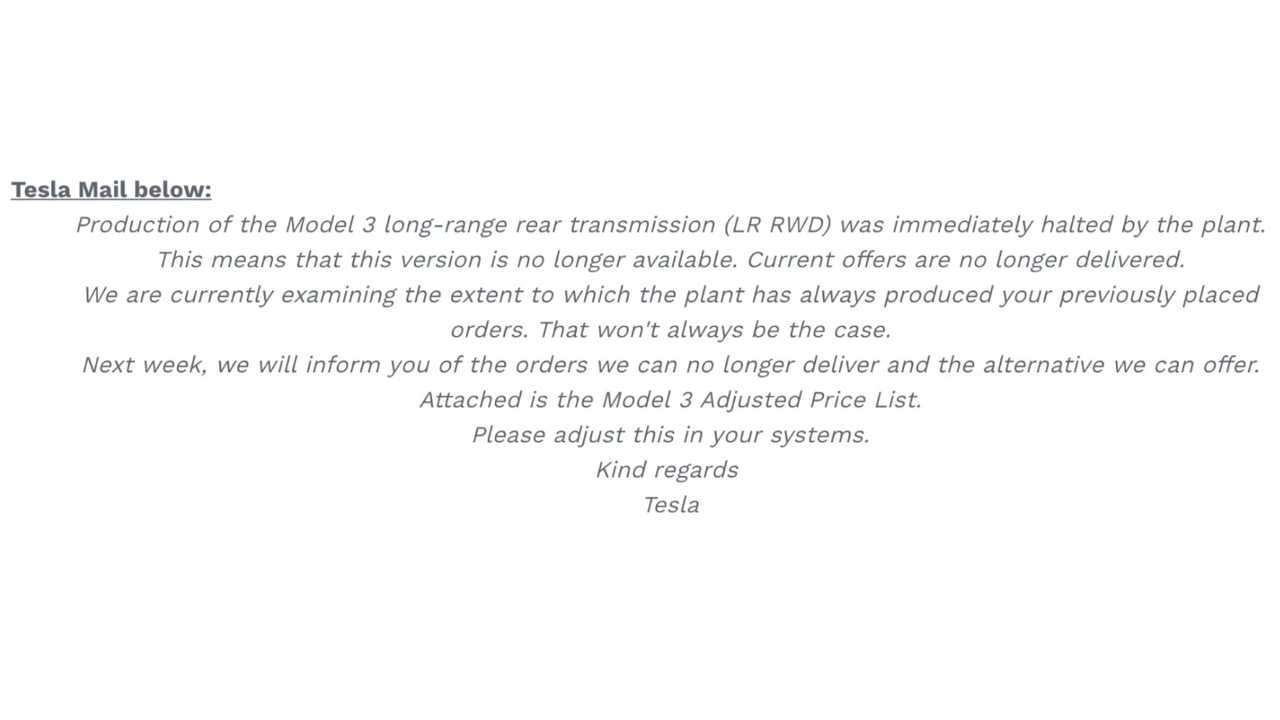
It isn’t known if this change is temporary, but Tesla did mention the Fremont plant “immediately halted” production for some reason or another. “Next week, we will inform you of the orders we can no longer deliver and the alternative we can offer,” said the Palo Alto-based automaker in an e-mailed statement.
If you’re looking for a reason, Tesla might’ve switched to all-wheel drive for the Long Range because the profit margin is higher. In terms of acceleration to 60 miles per hour, the rear- and all-wheel drive are extremely close. The difference boils down to five-tenths of a second (4.9 versus 4.4 seconds), and pricing starts at $49,000 before savings for the dual-motor option.
The Performance is $59,900 in the United Statesof America, and at the other end of the spectrum, the Standard Range Plus retails at $39,900. Both the Long Range and Performance promise 310 miles, the distance from Washington D.C. to Niles, Ohio. Not bad for an electric vehicle, but there’s room for improvement.
As far as Tesla is concerned, the Model S is king thanks to a maximum range of 370 miles. A refresh is coming for the 2020 model year, and chances are the Model S could get even better. The Model X is capable of up to 325 miles, and similarly to the sedan, the full-size crossover utility vehicle takes its mojo from a 100-kWh battery pack.

click to load Disqus comments for this storyThis enables Disqus, Inc. to process some of your data.

Manipulated Into Liking Cars
5 Must Have Truck Bed Accessories Your Pickup Badly Needs
Headwave TAG Helmet Music and Navigation System Reviewed

Smoke and Mirrors: Volvo's New Top Speed Limit
Engine Break-In: What You Need to Know
Aprils Fools' Pranks We’d Love or Hate to See Come True

Could Volkswagen Group's Electric Plans Include Ducati?
The Dos and Don’ts of Washing a Motorcycle, Part Two (Final)
The Biggest Anticipations in Motorcycling for 2016, Part 1

The Perversion of the Fast and the Furious
Upgrading Your Car: Top 5 Android Auto / Apple CarPlay Multimedia Systems
When Ford Told Ferrari to Shove It Using a Race Car

Car, Go Make Me Some Money!
5 Essential Car Accessories for the Summer Vacation
Alfred Neubauer: the First “Don” of Motor Racing

The Engine Start-Stop Systems Conspiracy
The Dos and Don’ts of Washing a Motorcycle, Part One
Lamborghini: the Italian Supercar Dynasty That Was Created Out of Vengeance

On Electric Harleys and New Generations
5 Top Rated Electric Scooters to Cure Your Lime and Bird Addiction
Can Cars Be Hacked? Inside Secure CSO Asaf Ashkenazi Says Yes. By Anyone

TESLA MOTORS models:TESLA MOTORS Model Y CrossoverTESLA MOTORS Roadster Coupe CabrioTESLA MOTORS Model S LuxuryTESLA MOTORS Model 3 Medium PremiumTESLA MOTORS Model X Large SUVAll TESLA MOTORS models

googletag.cmd.push(function(){ window.slot4 = googletag.defineSlot(“/1004334/AE_news_300x600_noref”, [300, 600], “AE_news_300x600_noref__slot_4”).addService(googletag.pubads()); googletag.display(“AE_news_300x600_noref__slot_4”); });if(typeof window.REQUEST_NONPERS !== “undefined”) { console.log(“manref”); googletag.pubads().refresh([window.slot4]); } '+'ipt>';
if(i==3) txt+='googletag.cmd.push(function(){ window.slot5 = googletag.defineSlot(“/1004334/AE_news_300x250_noref”, [300, 250], “AE_news_300x250_noref__slot_5”).addService(googletag.pubads()); googletag.display(“AE_news_300x250_noref__slot_5”); });if(typeof window.REQUEST_NONPERS !== “undefined”) { console.log(“manref”); googletag.pubads().refresh([window.slot5]); } '+'ipt>';
}

txt+=””+
“”+
“”+data[i][0]+””+
“”+
“”+
“”+data[i][2]+”
“+
“”+
“”+
“”;
}
txt+=””;

$('#morescroll').html(txt);

nxloaderactive=false;
});
}

function aenext_lzy() {
$(window).on(“scroll”, function() {
if(nxstories!=false) return;
var footOffset = $(“#footer”).offset().top;
if($(window).scrollTop() > footOffset – $(window).height() – 600) aenext_load();
});
}

function aenews_fixoverlaps_actual() {
window.aeoverlapst=-1;

var $rsoc=$(“.rightsocial”).first();
if($rsoc.length!=0) {
var rsocofs=$rsoc.offset().top;
var $newsgal=$(“.newsgal”).first();
if($newsgal.length==0) return;

var ngofs=$newsgal.offset().top+$newsgal.height();
if(rsocofs commentsOffset – $(window).height() – 400) anyclip_load();
}
}
}
function anyclip_load() {
var d = document, s = d.createElement('script');
s.src = 'https://player.anyclip.com/anyclip-widget/lre-widget/prod/v1/src/lre.js';
s.setAttribute('id', 'lre-player-widget');
s.setAttribute('pubname', 'autoevolutioncom');
s.setAttribute('widgetname', '0011r00002IZQzB_730');
(d.head || d.body).appendChild(s);
window.acLoaded = true;
}

Byton M-Byte electric SUV: More interior photos, US timeline confirmed

While the upstart electric vehicle maker Byton hasn’t yet said much about how its $45,000 M-Byte electric SUV will be sold or serviced in the U.S. it’s confirmed that this vehicle, due next summer, will come with a standout feature atop its dash: a wider screen than you might have in your living room.

The huge 48-inch Shared Experience Display spans the width of its M-Byte’s dashboard and incorporates gesture controls plus individual zones for the driver and passenger, a companion touchscreen tablet built into the steering wheel, and facial recognition and directional microphones to help cater functions to each occupant.

Although that might sound more like the pipe-dream domain of concept cars, the interface will be included even in the base M-Byte costing around $45k. And last week, with the official opening of its Shanghai Design Studio, the company released a few more up-close images that confirm a series of standout details making it into the production version.

Byton concept, 2018 Consumer Electronics Show

Some of the pragmatic concessions—like climate control vents and some hard buttons―that Byton added to its prototype version of the M-Byte for its most recent showing, this January, carry through to the production version.

Byton notes that the front seats, which can rotate inward up to 12 degrees, have made it from the M-Byte Concept all the way through to the production model—although we would assume the rotation is for when you’re parked. In all, Byton claims that 90 percent of the concept car’s design was retained.

The pictures confirm that although climate controls are in a smaller screen at the front of the center console, physical buttons for the front and rear defroster/defogger are higher up in the middle of the dash, as are the shift buttons.

Headquarters of Byton electric-car company, Santa Clara, California

Byton has its headquarters in Nanjing, China, with offices in Beijing, Shanghai, and Hong Kong. It retains an R&D center in Silicon Valley and its primary design and concept center in Munich, Germany.

When the Nanjing, China–built M-Byte shows up in the U.S., in mid-2020, according to the company, with a sales-and-service plan yet unannounced, it could slot into a compelling niche, costing tens of thousands less than alternatives from Mercedes-Benz, Audi, and Jaguar but a whole size larger than the Tesla Model Y.

Byton M-Byte concept

Byton told Green Car Reports last week that “the current tariff situation has not impacted Byton’s production and delivery timeline.” In addition to the North American rollout in 2020, it plans to sell the M-Byte in China starting late this year and in Europe in late 2020, and a full reveal is likely this fall.

Tesla On Track To Nail Its 2014 Forecast For 2020 Production & Sales

Invest
Electric Cars
Electric Car Benefits
Electric Car Sales
Solar Energy Rocks
RSS
Advertise
Privacy Policy

Cars

Published on June 16th, 2019 |

by Zachary Shahan

Tesla On Track To Nail Its 2014 Forecast For 2020 Production & Sales

Twitter
LinkedIn
Facebook

June 16th, 2019 by Zachary Shahan

Preface: I first published this article in March 2018. A recent tweet highlighting a 2014 interview with Elon Musk reminded me of it, and since the piece is as relevant today as ever, I’m reposting it below with only minor changes. Enjoy!

I think it was April 2013 when we first got word that Tesla Model 3 production would probably start in 2017. Well, we didn’t have a name for the car yet, so we called it “Tesla’s fourth production model.” Tesla CEO Elon Musk was apparently hoping for a 2016 release, but quietly knew and told himself 2017 was more likely. His exact response to some questioning from Engadget on the matter: “Hopefully 2016, but I would say no later than 2017.”

In August 2013, we found out the name was probably going to be Tesla Model E. Tesla tried to trademark that name to have some fun with the spelling of its eventual vehicle lineup (S-E-X-Y). However, Ford apparently had the trademark “Model E” and didn’t want to give it to Tesla, so Tesla later changed the name to Tesla Model ☰ (aka Tesla Model 3).

What’s interesting to me here is that the statement the car would be in production by 2017 was accurate even though that was long before the car was even named Model 3.

Furthermore, for all the hype of the Model 3 being delayed, look, production actually began on the Model 3 within the timeframe Elon estimated way back in 2013.

I think the 2017 estimate was mentioned by Elon again in the following year, but I’m not finding any reference to that in our archives.

In late November 2014, I polled our readers about the 2017 production target for the Tesla Model 3. The target at that time didn’t include any forecast for the number of cars produced — just that production on the Model 3 would start by the end of 2017. The majority (62.5%) of our Tesla enthusiast/fanboy readership responded that they didn’t think the Model 3 would arrive in 2017. (Note, in case you missed it: the Model 3 did arrive in 2017.)

By the way, in October or early November 2014, Jerome Guillen (then Tesla’s “Chief Designer,” then head of the Tesla Semi project, and now Tesla President of Automotive) stated that Tesla was aiming to produce 500,000 cars/year by 2020. Presumably, if people thought the Model 3 wouldn’t arrive on time, they also thought the 500,000 cars/year by 2020 goal was unrealistic, but we didn’t poll that. Tesla later moved up the 500,000 by 2020 goal to a goal of 500,000/year by 2018 (in response to massive consumer demand for the Model 3). Even though this stretch goal wasn’t achieved, the 500,000 cars/year by 2020 goal still seems like a good possibility.

As a side note: We heard rumor in June 2015 that the Model 3 would actually have a range of 250 miles per charge, not simply the promised 200 miles. That was a big rumor, and we weren’t sure whether to get excited or be skeptical. As it turns out, the base Model 3’s EPA-rated range is 220 miles, the most popular trim, model 3 Standard Range Plus, has a range of 240 miles, and the Model 3 Long Range has 310 miles of range.

In August 2015, these were some of my notes from a Tesla quarterly shareholder report:

The Model 3 design will be revealed in the first quarter of 2016. (Woohoo!)
First deliveries are still expected in late 2017.
Basically, the 3 is still on schedule, but there’s not much more to say at this point.
Tesla thinks it is still on track for 500,000 cars a year by 2020, and that it might even go beyond that. 500,000 is based on Fremont factory production capacity, but Tesla may localize production in some places in 3–5 years. (Update: We now have the Chinese Tesla Gigafactory rapidly moving toward completion.)

Again — first deliveries did occur in 2017. Actually, first deliveries came in the middle of 2017, not the end of 2017. However, it’s true that first deliveries to non-staff customers came in late 2017.

Now, I would also note here that Elon never claimed mass production would begin right off the bat. Anyone familiar with ramping up production of a new vehicle would know that’s not how it would happen. Taking that into account, start of production in the middle of 2017 and slowly ramping that up (with hiccups) through the end of 2017 and beginning of 2018 was actually ahead of the schedule we presumed back in 2015.

And, again, if you look at our 2014 poll, even bullish Tesla fans largely didn’t expect Tesla to get the Model 3 into production in 2017. (Context, Sherlock, context.)

I’ve got another “by the way” note for you. In late 2015, Elon stated: “And with the (Tesla) Model 3 and various iterations on that platform, I’m really confident that we can do, you know, another 300,000 or 400,000 cars per year.” That implies that Elon thought annual demand and production of the Model 3 and Model Y (at least) would total 300,000–400,000 units per year (combined).

Mr. Musk’s 2016 view on that topic was that he expected demand for the Model 3 and Model Y to be approximately 500,000–1,000,000 units a year each — which implies 1–2 million units a year combined. I haven’t seem him change course on that general expectation.

In other words, Elon’s 2015 timeline for the Model 3 turned out to be essentially accurate but he was drastically underestimating demand compared to today’s expectations. (Sound familiar?)

When did the mid-2017 start of production target first come into play? On May 4, 2016, Elon hesitantly shared the accelerated target. You could tell before he said it that he didn’t really want to share the dates, but my guess is he figured the word would get out anyway (or he was just trying too hard to explain how the tofu is made). He unveiled that the official Tesla target for start of production was July 1, 2017, but he emphasized that the target was for suppliers just to try to get them to deliver in a reasonable time frame. The realistic target for actual beginning of production remained late in 2017.

As it turned out, in the beginning of 2017, everything seemed to actually be on schedule for start of production in July 2017. It was shocking. Most people didn’t believe it. Hardcore critics still claimed Model 3 production wouldn’t start until 2019 or 2020 or something like that.

No, volume production didn’t start in the summer or ’17, but production of the Model 3 did indeed start. By that time, of course, many a skeptic, “very serious analysts,” and naysayers dropped their claims of Tesla being unable to produce the Model 3. They stopped stating with 100% certainty that it would be years before the Model 3 went into production, if it ever did. They dropped their claims that there was no way Tesla would hit its targeted “end of 2017” start of production. Nope, the goal posts had moved.

And in the second half of 2017, it finally happened. Tesla finally fell behind on some of its stated production targets for the Model 3. Bottlenecks with battery production in particular — which Elon Musk admitted was ironic and presumably due to misplaced complacency — slowed down Tesla’s Model 3 production ramp. Perhaps other bottlenecks are at play as well, but we haven’t really heard of anything else. Anyhow, with even one critical machine down and one piece of the car coming out slower than planned, Tesla missed a few Model 3 production forecasts. It’s not fun. It’s yet another sign that Tesla and Elon do not defy the laws of this universe and are indeed fallible. But it’s also a bit extreme, short-sighted, and disingenuous to act like Tesla is always late, only late, and needs to find a working watch.

In fact, the bottlenecks in the second half of 2017 didn’t stop Tesla from reaching Model 3 production in 2017, as it had targeted back in 2013 or even earlier. The bottlenecks slowed down the production increases Tesla was aiming to achieve, but they’ve more or less left Tesla where it was expecting to be when it was forecasting the story back in 2013, 2014, 2015, and 2016.

Elon gets slammed quite frequently for being overly optimistic with timelines. If you look at what he said back in 2013 about Model 3 production beginning no later than 2017, the man was accurate. His estimate was on the mark. His timeline (not quite his hopes, but his committed timeline) was right on the mark.

Who trusted his timeline? Who expected he would actually get the Model 3 into production in 2017? Not many people. And certainly not the people who said Tesla would crash in burn in 2013, in 2014, in 2015, in 2016, and yet again in 2017.

When considering who is more accurate with timelines, perhaps it’s time to give Elon a little more props and a little less sass.

As a final note, remember, many critics also repeatedly said the Tesla Model X couldn’t be mass produced. Some “very serious industry analysts” claimed it was fundamentally impossible. But that’s a story for another day.

About the Author

Zachary Shahan Zach is tryin' to help society help itself (and other species). He spends most of his time here on CleanTechnica as its director and chief editor. He's also the president of Important Media and the director/founder of EV Obsession and Solar Love. Zach is recognized globally as an electric vehicle, solar energy, and energy storage expert. He has presented about cleantech at conferences in India, the UAE, Ukraine, Poland, Germany, the Netherlands, the USA, and Canada.

Zach has long-term investments in TSLA, FSLR, SPWR, SEDG, & ABB — after years of covering solar and EVs, he simply has a lot of faith in these particular companies and feels like they are good cleantech companies to invest in. But he offers no professional investment advice and would rather not be responsible for you losing money, so don't jump to conclusions.

Back t..
Domino’s serves up self-driving pizza delivery pilot in Houston

Domino’s really emphasizes its commitment to ‘innovation,’ but even if it’s a marketing tactic, the global pizza brand does indeed walk the walk. Case in point: It’s launching a new pilot for self-driving pizza delivery in Houston in partnership with Nuro. Autonomous driving tech startup Nuro was founded by Dave Ferguson and Jiajun Zhu, two… Continue reading Domino’s serves up self-driving pizza delivery pilot in Houston

Tesla Discontinues Long Range Rear-Wheel Drive Model 3

In the latest edition, the Model 3 LR RWD was rated at 325 miles (523 km) of range. Now, customers need to choose between shorter range or all-wheel drive versions. One of the latest change in the constantly changing Tesla offer is reportedly the discontinuation of the Long Range Rear-Wheel Drive version of the Model… Continue reading Tesla Discontinues Long Range Rear-Wheel Drive Model 3