10.
March 2020
Stuttgart
Sales record in 2019 with 438,400 vans sold worldwide Transformation initiative intensified with three pillars: Performance, Strategy and Transformation Systematic electrification of the product portfolio Marcus Breitschwerdt, Head of Mercedes-Benz Vans: “2019 was a challenging year for us in which we made groundbreaking decisions in order to put the van back on a successful track.” Stuttgart – In 2019 Mercedes-Benz Vans achieved a new best in the Group sales in a difficult environment, having sold a total of 438,400 vans (+4%). Revenues also developed positively to 14.8 bill. Euros, whilst the EBIT was significantly negative due to numerous one-time effects (-3.1 bill. Euros). Adjusted to take account of the one-off effects, Mercedes-Benz Vans achieved a positive operative result totalling 284 mill. Euros. Back in 2019, the business unit's management made groundbreaking decisions for the sustainably successful future of Mercedes-Benz Vans.
“2019 was a challenging year for us. So I'm all the more delighted that we were able to increase sales for the seventh year in succession with our impressive products,” said Marcus Breitschwerdt, Head of Mercedes-Benz Vans. “In the past year not only did we successfully position the new V-Class on the market and present the EQV* as our first electrically driven MPV; we also celebrated start of production of the eSprinter and further extended our range of connectivity services.” Breitschwerdt continued: “Furthermore, we have made groundbreaking decisions in order to put the van back on a successful track. This includes revising our product portfolio as well as setting up what we call a Transformation Office, which will be actively driving forward the change.”
*(combined power consumption: 26.4-26.3 kWh/100 km; combined CO2 emissions: 0 g/km)[1]
Own unit for transformation at Mercedes-Benz Vans
With Boost, the efficiency and transformation initiative, which Mercedes-Benz Vans embarked upon at the beginning of 2019, important leverage was established. In order to anchor the initiative even more emphatically for Mercedes-Benz Vans, the Boost Transformation Office (BTO), an organisation dedicated to the three pillars Performance, Strategy and Transformation, was set up at the start of February 2020.
With Boost Performance the main emphasis is on cost optimisation. Boost Strategy focuses on the realignment of Mercedes-Benz Vans as part of the product, sustainability and business unit strategy. Boost Transformation is continuing the cultural change.
Strong product portfolio
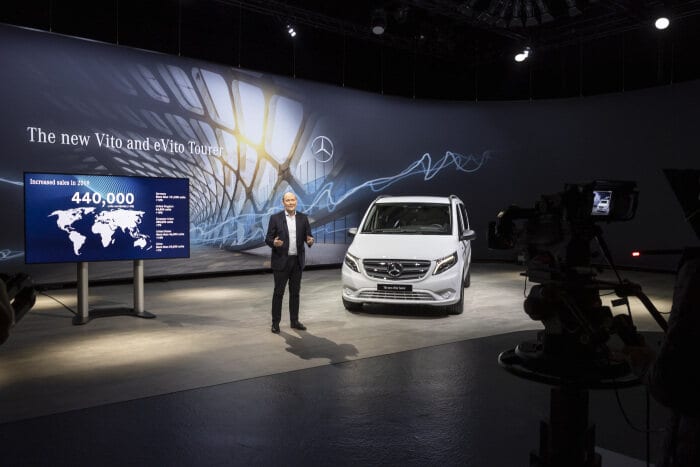
Today saw the public unveiling of the revised Mercedes-Benz Vito and eVito Tourer models (combined electrical consumption: 26.2 kWh/100 km; combined CO2 emissions: 0 g/km)1. The Vito is purchased predominantly for commercial use in the mid-size segment. The facelifted Vito impresses with features such as a new engine (OM 654) for all variants with front-wheel drive, the AIRMATIC suspension for higher ride comfort, more safety thanks to DISTRONIC and Active Brake Assist as well as a digital inside rearview mirror. The eVito Tourer boasts the same qualities, and has up to nine seats, making it ideal for passenger transportation, with its electric drive achieving an output of 150 kW and a range of 421 kilometres[2], [3].
Since the current model was launched in September 2014 the Vito has been sold more than 508,000 times worldwide. The models in the mid-size segment are now available in more than 100 countries around the world. They are built in Vitoria, Spain, and “made in China for China” at The Chinese Daimler Joint Venture Fujian Benz Automotive Co. Ltd. (FBAC) in Fuzhou. In Charleston, South Carolina, the Vito is built for the US market under the name Metris.
The Citan urban delivery van has been serving the small-van segment since 2012. Mercedes-Benz Vans will systematically continue its commitment to this segment together with the Renault-Nissan-Mitsubishi cooperation network and in this context it has decided to produce a successor to the Citan. The successor model will also be offered as a battery-electric variant.
Mercedes-Benz Vans continues to drive electrification of the product portfolio
With eDrive@VANs, Mercedes-Benz Vans is systematically driving forward the electrification of its product portfolio with locally emission-free electric drives, contributing to sustainable mobility in delivery and passenger transport. The first of these vehicles was the eVito Panel Van, closely followed by the eVito Tourer. The end of 2019 saw the start of production of the eSprinter in Düsseldorf. Also in 2019 Mercedes-Benz Vans presented the EQV (combined power consumption: 26.4-26.3 kWh/100 km; combined CO2 emissions: 0 g/km)1, its first purely battery-electric premium MPV. The vehicle offers a range of up to 417-418 km2, 3 with unrestricted use of its interior. Mercedes-Benz Vans has also announced an electric variant of the Citan, reaffirming its aim to electrify all model series.
Our goal is a holistic electric solution that not only reduces the strain on cities and the environment, but also offers our customers genuine benefits. Electric mobility is considered way beyond the vehicle itself here: Mercedes-Benz Vans offers a holistic ecosystem which is developed in close cooperation with customers for an outcome precision-tailored to their sector.
“The electric drive will gain more prevalence in the coming years as it becomes a strong mainstay of our product portfolio”, Breitschwerdt emphasises.
“With the eVito and the eSprinter, we consistently electrify our commercial vans,” Breitschwerdt continues. “The eVito has been on the market since 2018 and is in high demand. Thanks to our flexible production strategy, which allows us to produce both conventional and battery-electric vans on one production line, we can respond very well to the changing demand for eVito and eSprinter. And I am particularly pleased about the already high capacity utilisation for 2020. We are confident that the revised eVito Tourer will be able to inspire other customers – in the field of passenger transport, for instance. ”
The new Mercedes-Benz eVito Tourer takes on the autonomous look of its brothers with a combustion engine. But beneath the dynamic front with a charging connection in the bumper at the front left is the electric drivetrain (eATS), which powers the front wheels with a peak output of 150 kW. The electric motor, the transmission with fixed transmission ratios, the cooling system and the power electronics form a compact unit. The energy is stored in a lithium-ion battery in the vehicle's underbody. It is configured low down and centrally, which has a positive effect on the eVito Tourer's handling. The top speeds of 140 km/h with standard and 160 km/h with special equipment ensure rapid progress out of urban traffic, too. The
Mercedes-Benz eVito Tourer comes as standard with a water-cooled on-board charger with alternating current with an output of 11 kW. This means that it is also prepared for AC (alternating current) charging at home or public charging stations. Things can be sped up using the Combined Charging System (CCS) with direct current (DC) or alternating current (AC). In Europe the eVito Tourer thus charges at one of these stations with a maximum output of up to 110 kW in optional guise, the standard output being up to 50 kW. The charging time of 10 – 80 percent SoC (State of Charge) is thus around 45 minutes at 110 kW. The battery with a usable capacity of 90 kWh facilitates a range of 421 kilometres1, 2.
[1] Electrical consumption has been determined on the basis of Directive 692/2008/EC. Electrical consumption is dependent on the vehicle configuration.
[2] Electrical consumption and range have been determined on the basis of Directive 692/2008/EC. Electrical consumption and range are dependent on the vehicle configuration.
[3] The actual range is furthermore dependent upon the individual driving style, the road and traffic conditions, outside temperature, use of climate control/heating system, etc. and may differ.
Press Contact
Silke Walters
Manager Global Business Communications Mercedes-Benz Vans
silke.walters@daimler.com
Tel: +49 176 30909308
Benjamin Oberkersch
Spokesperson Van Technology Communications – eDrive@Vans
benjamin.oberkersch@daimler.com
Thomas C. Rosenthal
Global Technology Communications Mercedes-Benz Vans – Future Transportation & adVANce
thomas_christian.rosenthal@daimler.com
Tel: +49 176 30933075
Press Contact Overview
Media
Download
Pictures (1)
Documents (1)
Media Contact (3)
Filter
Show thumbnails
Show list
Slideshow
Settings
Preview
Do you really want to delete the data record?
Please wait a moment …
Please wait a moment …
Please wait a moment …
Please wait a moment …
20C0161_02
Legend
:
Digital Premiere Vito and eVito Tourer (combined power consumption: 26.2 kWh/100 km; combined CO2 emissions: 0 g/km)*, in the picture: Marcus Breitschwerdt, Head of Mercedes-Benz Vans
Release date
:
Mar 10, 2020
Loading